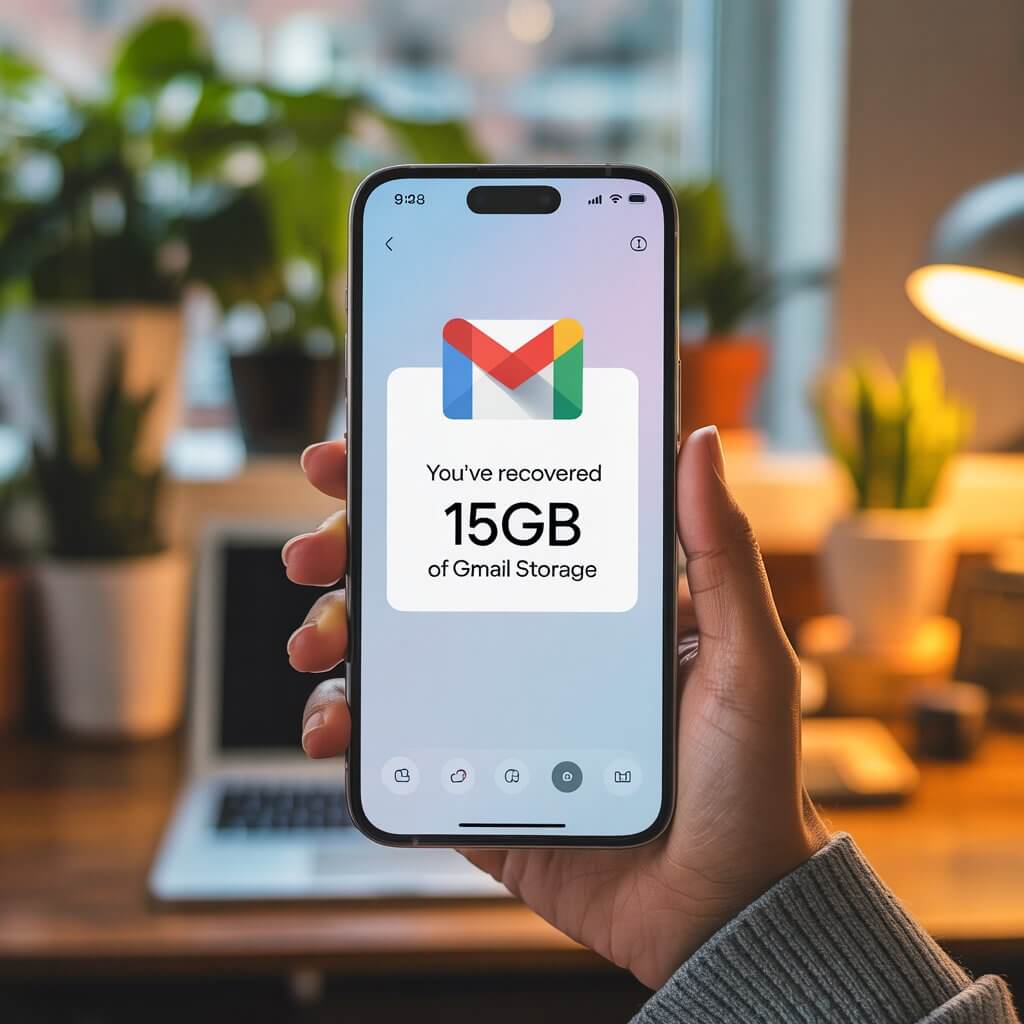
Have you received the dreadful “Account storage is full” message? You may quickly clear out your Gmail inbox without erasing anything.
It is possible to return to inbox zero while retaining all of your previous messages.
Since middle school, I’ve had a Gmail account. I’ve gathered hundreds of unopened emails over the years, and I honestly don’t have the finest email hygiene. I was aware that I would eventually have to purge my inbox, but it was difficult to decide which emails were important enough to save.
I got a better idea just as I was about to give up and start paying for more Gmail storage. I discovered that I could restore 15GB of free storage while retaining all of my previous emails, and it would not cost me a dime.
To keep all of my current communications, I just needed to set up a second Gmail account. I could create a dedicated archive account and move all of my old emails to it because there is no limit on the amount of free Google accounts you can have.
If you have a work or school Gmail account that you won’t be able to access indefinitely, transferring your mails is also an excellent tactic. You must transfer your old messages and files to a personal account before you lose access because the majority of colleges and companies will deactivate your account after you are no longer enrolled or employed.
It doesn’t take long to finish moving all of your Gmail messages to a new account, but how long it takes depends on how many messages you have. I’ll take you through the easy process of moving your emails from your old account to a new one, making sure to backup all of your data first.
How much data does Gmail allow you to store?
When you create a Gmail account, fifteen megabytes of free storage can seem like a lot, but it rapidly fills up. The 15GB is utilized for more than just email, to begin with. It also contains the things that you have stored in Google Drive and Google Photos.
The “Account storage is full” notice will appear soon if you send or receive messages that contain large items, including films, on a regular basis or if you upload a lot of images and videos to your Google Photos. You should take immediate action since this implies that you will no longer be able to send or receive emails using this account.
Getting a Google One account is the easiest fix. You will still have to pay for the storage of old emails that you may no longer require, even if you choose for the cheapest plan ($20/year for 100GB).
You may always remove your old emails if you don’t want to purchase more storage. By throwing huge files in the trash, you may recover a surprisingly substantial amount of storage space. You can easily find and remove files by size with Gmail. That choice, however, may sound tiresome; perhaps you don’t want to spend hours sorting through letters from ten or more years ago, choosing which memories to save and which to discard forever.
Large files can always be downloaded to your desktop before being removed from your Google account, but eventually you’ll most likely have the same problem with your local files and need to control the amount of storage space on your computer.
We now arrive at our “nuclear option:” moving all of your emails to a different Gmail account.
How to move your Gmail correspondence to a different email address
I advise you to backup your emails before beginning the Gmail migration procedure. You may accomplish this by downloading your emails to an external hard drive or your PC. After you’ve finished moving the emails to your new account, you may remove the backup if you’d like, although it’s always a good idea to keep a backup copy locally.
Go to Google Takeout to backup your Gmail messages. I received a download from Google Takeout in around two hours using my test Gmail account, which had over 75,000 mails.
You may start moving your emails once you’ve saved a duplicate of them. The actions you must do are as follows:
- To begin, sign in to your original Gmail account, choose “See all settings” by selecting the “gear” symbol in the upper right corner.
- Choose the Forwarding POP/IMAP tab, and under the Enable POP for all mail (POP is an acronym for Post Office Protocol) option, click.
- Under “When messages are accessed with POP,” you’ll see a number of settings. Choose “delete Gmail’s copy” to have the emails from your old account deleted automatically following the transfer.
- Click “Save Changes.”
The next step is to register for a new account and move all of your communications there:
Create a brand-new, inbox-zero Gmail account (which we’ll refer to as your archive account) if you haven’t already.
- Sign in to your newly created archive account, then choose See all settings by clicking the gear icon at the top.
- Choose Add a mail account next to Check mail from other accounts after selecting the Accounts and Import option at the top.
- Type the name of your initial Gmail account in the pop-up box. Click Next.
- Choose Import emails from my other POP3 account, then click Next once again.
- Type in your Gmail account’s original password. Additionally, you might need to generate a password for the Google app (see note below).
- Under Port, choose 995.
- Check out these three boxes: When retrieving mail, always utilize a secure connection (SSL). Incoming communications should be labeled and archived (skipping the inbox).
- Click “Add Account.”
To transfer Gmail messages, you’ll most likely need to set up a Google app password.
The normal password for the Gmail accounts did not work on either of the two occasions I attempted this Gmail message transfer method. I found that in order to sync the accounts, I would have to make a temporary “app password” after doing some research.
Google app passwords are 16-digit passcodes designed to grant access to your Google account through “less secure” apps or devices. They function in the same way as your Google password.
To create an app password if your standard Google password isn’t working for synchronizing Gmail accounts, go to https://myaccount.google.com/apppasswords. Just give the password a name (I chose “Transfer Bulk Email”) and click the “Create” button. Your new 16-digit passcode will appear in a pop-up window.
After creating the app password, go back to step 6 of the previous instructions and substitute the new password for your regular one.
Important: Your app password will only be shown once by Google. You can’t request to view it again once you’ve generated it, so make sure you write it down or otherwise document it.
According to Google’s Help Center, “app passwords aren’t recommended and are unnecessary in most cases.” Therefore, I advise removing your app password after you’ve finished moving your Gmail messages.
After syncing my Gmail accounts, what happens?
Your emails should start moving automatically as soon as you’ve successfully connected your new Gmail archive account to your old one. Depending on how many emails you have, the procedure might take a few hours or days.
It took Gmail around two full days to move all of the messages from the original account to the new archived mail account in my test account, which had roughly 75,000 messages.
Crucial: Your original Gmail account will save all of your messages in the Trash folder, which you will need to manually clear after moving them to your preserved mail account. It took around an hour to remove those 75,000 texts from the trash.
My test account was consuming little over 12GB, or 80%, of Google’s free 15GB before I started moving Gmail messages. The account was only consuming 0.66GB after the move, with 0.06GB coming from Gmail.
Which Gmail mails are not going to be moved?
All of my mails were transmitted via Gmail, with the exception of two categories: drafts and spam.
You will have to manually determine how to handle your drafts. Every 30 days, spam messages are automatically removed, so you may either let Gmail take care of that or, after moving your mail, go into the Spam folder and either delete or forward those items.
Experience inbox zero once all of your emails have been moved to your new account. You’ve breathed new life into your first account.
There are now two last actions to take: In order to keep using your original account, you need to stop the automated transfer procedure. If you have to create an app password, you should also remove it.
- Sign in to your new account, then choose See all settings under Settings.
- Click on the Accounts and Import tab. Then, under Check mail from other accounts, choose delete for your original account.
- Choose OK when asked to confirm the deletion of the mail account.
Go back to https://myaccount.google.com/apppasswords and click the trashcan button next to the password you generated if you had to make one and would like to remove it right away.
Well done, you’re done.
Last but not least, accounts that have not been used for more than two years will be deleted by Google. Therefore, after transferring all of your old emails, be careful not to dismiss them entirely. You may keep your archive account alive by logging in at least once every two years, even if you don’t intend to use it frequently for email correspondence.
Do You Have Any Prime Day Remorse? My Trick for Getting Free Returns on Amazon Items
Here’s how to return an item for free and receive a refund if your Prime Day purchase doesn’t live up to your expectations. No, returning something from Amazon doesn’t cost you anything.
The extended July Prime Day promotion on Amazon is now over. This year’s sale lasted four days, rather than just two days with good bargains. That gives you a few more days to add anything you might have overlooked to your cart. Here’s what to do, though, if you weren’t happy with your Amazon Prime Day purchase.
In case you were unaware, Amazon offers a few free ways for you to return products that you’re not pleased with. However, if you decide to use the UPS Store, be aware that there is now a $1 fee. Here’s everything you need to know to avoid needless costs and hassles after shopping Prime Day offers, regardless of how you choose to return products.
Get your comeback off to a good start.
To start, choose the item you wish to return from your Amazon Orders page. After deciding on a return reason, go over your alternatives for pickup and drop-off. Amazon will display the sites that qualify.
Look for returns that are stamped “no-box, no-label” if your item is eligible for more than one return method; these are your free-ticket returns.
Free local return alternatives for Amazon
Staples and Kohl’s
Amazon returns are accepted at no cost in Kohl’s and Staples stores throughout the United States. Simply select one of these stores to drop off your item when you start your return. There’s no need to repackage the item; you’ll receive a QR code to scan in-store.
Even better? You could receive in-store discount coupons from certain retailers simply for visiting.
Whole Foods Store
Returns can also be dropped off at specific Whole Foods stores. You will receive a QR code to scan upon arrival, much like at Kohl’s. Check the return guidelines at checkout because not all Whole Foods shops accept Amazon returns, and some might ask you to package the item in advance.
Amazon Lockers, Amazon Fresh, and Amazon Go
You might be able to drop off your item at an Amazon-owned store, like Amazon Fresh or Amazon Go, if you’re fortunate enough to live close enough. Select Amazon Store Drop off and adhere to the guidelines. Although supplies could be accessible on-site, you will often need to package your return for Amazon Hub Lockers beforehand.
Options for UPS returns: Is it free or paid?
Delivered to the UPS Store
Unless there is a nearby free spot, UPS Store drop-off is frequently free. If so, you can be assessed a $1 convenience fee by Amazon. The UPS Store will take care of the labeling and packaging, and you will still receive a QR code.
Arrange for a UPS pickup.
Amazon allows you to order a UPS pickup from your home for the utmost convenience. UPS provides the label, but you will be responsible for packing the goods yourself. Depending on the goods and your area, there can be a minor price even though this might be a terrific alternative. Throughout the return procedure, Amazon will keep you informed.
Disclaimer
This article is for informational purposes only and is based on publicly available tools and services provided by Google. We do not promote or endorse any unauthorized modifications or misuse of Google’s services. Always follow Google’s official guidelines when managing your data and account settings. Any trademarks mentioned belong to their respective owners. This post may contain affiliate links or recommendations, but all opinions expressed are solely those of the author.